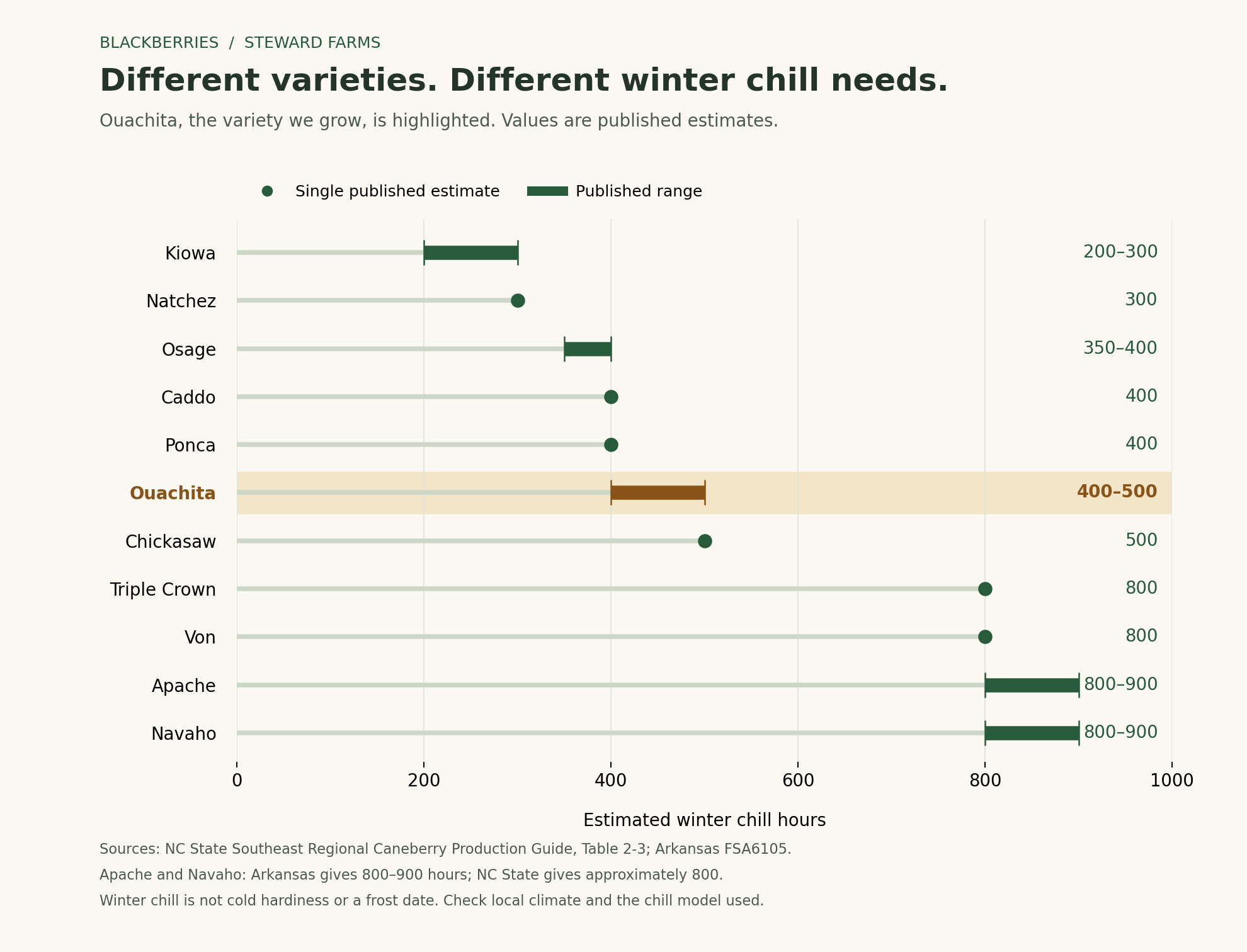
Blackberry winter chill comparison
Showing 11 varieties.
What these hours mean
Winter chill accumulates during cool weather and supports normal bud break and fruiting. The regional guide describes hours between 32°F and 45°F; other models count differently. This is not a continuous cold treatment, a hardiness-zone rating or a spring planting date.
Check local seasonal records and cultivar performance. A lower requirement does not make a variety better everywhere, and sufficient chill alone does not guarantee a crop.
Estimates and sources
| Variety | Chill hours | Thornless? | Source |
|---|---|---|---|
| Kiowa | 200–300 | No | Arkansas |
| Natchez | 300 | Yes | NC State |
| Osage | 350–400 | Yes | NC State |
| Caddo | 400 | Yes | NC State |
| Ponca | 400 | Yes | NC State |
| Ouachita | 400–500 | Yes | Arkansas / NC State |
| Chickasaw | 500 | No | Arkansas |
| Triple Crown | 800 | Yes | NC State |
| Von | 800 | Yes | NC State |
| Apache | 800–900 | Yes | Arkansas |
| Navaho | 800–900 | Yes | Arkansas |
Apache and Navaho use Arkansas’s 800–900-hour range; NC State lists approximately 800 hours. These are source differences, not a statistical confidence interval. Ouachita’s 400–500-hour estimate appears in both sources.
This comparison covers floricane-fruiting varieties. Primocane-fruiting plants need separate crop-cycle context and are not included here.
Sources: NC State regional cultivar guide, Table 2-3; Arkansas Extension FSA6105. See also Mississippi State’s explanation of chilling models.
What if your winter does not provide enough chill?
Some growers supply part of the cold exposure in a controlled cold room. The plant still needs an appropriate seasonal cycle; the equipment changes where the cold comes from.
University research includes Ouachita grown as dormant containerized long canes, using a walk-in cooler at about 39°F (4°C). That is a different stage from a small green plug or a shoot in a tissue-culture jar. Read the 2025 study.
Does purchasing a walk-in freezer solve the problem?
The actual operating conditions matter more than the box’s name. The cooler treatment above does not support putting young plants into an ordinary freezer setting. Equipment needs to suit a defined production plan; no particular freezer conversion is validated here.
After storage, plants still need a suitable growing environment. The university’s 2026 field-day report describes growers exploring containers, walk-in coolers and hoop houses.
Can I use this map to calculate days in a cooler?
A station’s five-period mean is not a measurement of a particular plant’s chilling. Do not subtract that average from a cultivar number and treat the difference as a storage recipe. Keep the outdoor climate comparison separate from a plant-specific controlled-chilling plan.