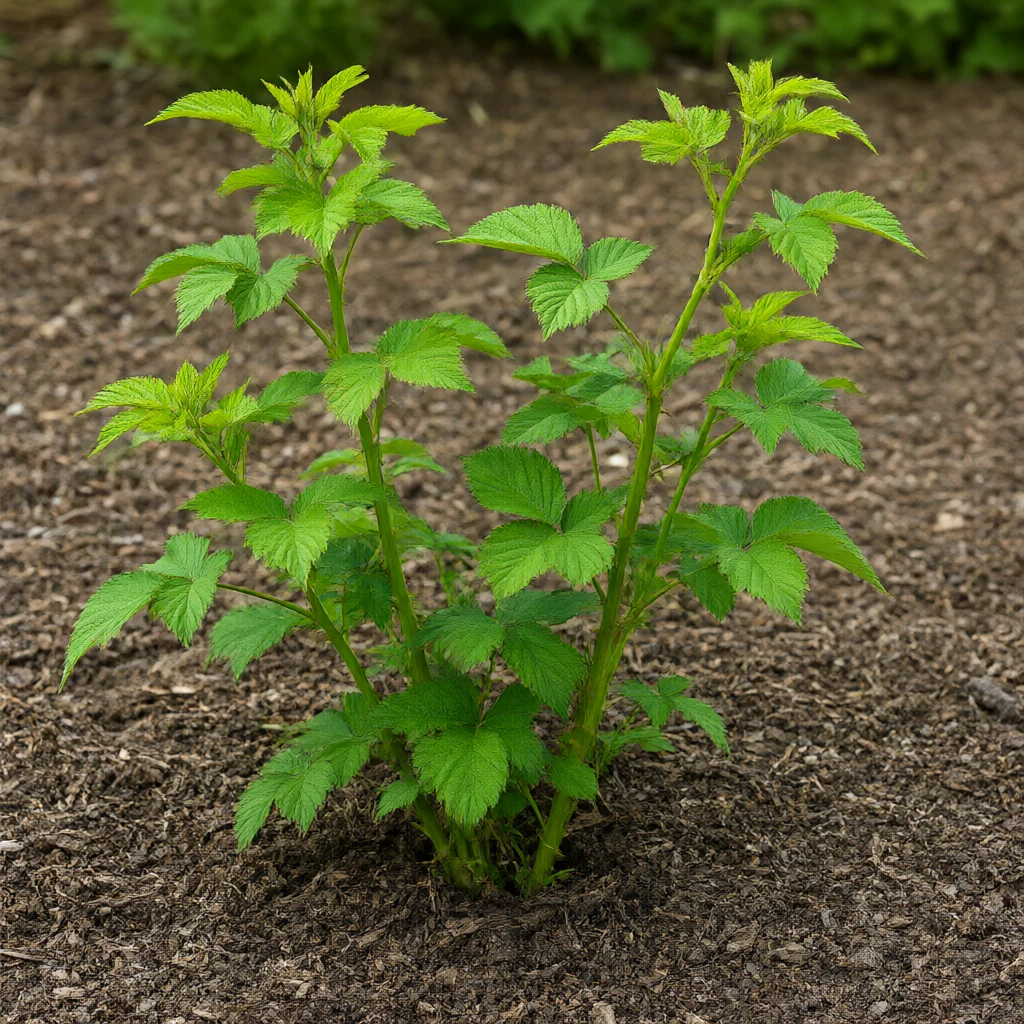
A young blackberry can spend its first season doing important work that never appears in a fruit bowl. Roots occupy new soil. Leaves unfold. Canes lengthen. To someone waiting for berries, that can look like a delay. To the plant, it is part of building the structure a later harvest will need.
Ouachita rewards a gardener who learns that structure. The variety has erect, thornless canes, but those useful traits do not make a newly established plant equivalent to a mature row. The first-year job is to help the plant settle into an appropriate site and to learn which changes belong to its normal development.
This is a care guide for the season after a nursery plant reaches its growing place. The immediate transition from shipping belongs in our arrival guide. Here the focus is longer: how to observe progress, connect care to the site, and understand why new leafy growth does not always come with fruit. A simple record of what happened is often more useful than a firm harvest promise made before the plant arrives.
Begin with the stage you actually received
A propagation label does not tell the whole story of a plant’s present needs. A shoot in culture, a rooted nursery plug, and a larger potted plant may share a cultivar name while differing in the environments they have experienced. Start with the grower’s description of the sale stage and its accompanying care instructions.
The regional establishment guide distinguishes green plugs from dormant stock and explains their transition toward planting. That distinction should stay attached to the plant even after the excitement of arrival has passed. Keep the label and any written instructions where they can be found.
Take a starting photograph with something that gives a sensible scale. Note the date, pot or plug size, planting date, and visible cane growth. The picture is a reference for later comparison, not proof of a particular health status. It lets the next observation begin with something more specific than remembering that the plant used to be smaller.
Learn the two-year cane story
A blackberry’s persistent root system and its individual canes do not follow the same clock. A first-year cane is called a primocane. A second-year cane is called a floricane. For floricane-fruiting blackberries such as Ouachita, recognizing those stages helps explain where a later crop can develop.
Clemson’s home-garden guidance describes that cane cycle. It is the reason a gardener should hesitate before cutting all growth down simply because winter has arrived. A cane that has not yet fruited may be part of the next cycle rather than useless leftover wood.
The calendar alone cannot identify every cane. A planting can contain different ages together, and the history of a purchased plant may differ from a small newly established plug. Ask what material was supplied, then follow what actually grows. Learning the names gives the gardener a vocabulary; observation connects those names to the plant.
Explore the stages before setting a harvest deadline
Choose a phase in the explorer below. Each describes a different way to read the plant’s progress. The stages explain a cycle; they do not assign every plant the same size or guarantee fruit in a particular month.
Try it as you read
Follow the cane cycle
After exploring, choose one observation for the current phase. During establishment, that might be recording new growth and root-zone moisture. As canes overwinter, it might be identifying which growth is being retained. In an established planting, it might be marking fruiting history so next season’s pruning makes sense.
That small choice turns a general explanation into a habit. The gardener no longer has to ask whether every day without berries represents failure. There is another question to answer: is the plant making appropriate progress for the stage it has reached?
Give roots both moisture and a suitable site
Watering is not a fixed number of cups assigned to every blackberry. Soil, potting material, weather, plant size, and the condition of the root ball change the situation. A small plug entering a garden bed is not the same watering problem as an established plant occupying a much larger soil volume.
Check the actual root zone instead of assuming surface appearance tells the whole story. Keep the original root ball in mind after transplanting; moisture in surrounding soil does not automatically describe the material the nursery roots occupy. Follow the grower’s stage-specific instructions and adjust observations as the plant establishes.
Site drainage belongs in this conversation too. UGA’s home-garden guide emphasizes suitable soil and avoiding standing water. Watering more cannot correct every site problem. If the planting area stays wet after rain, investigate the location rather than repeatedly changing the amount applied without understanding where the water goes.
Feed according to evidence, not impatience
A gardener waiting for visible growth may be tempted to add fertilizer whenever the plant seems slow. That can turn a useful observation into an unrecorded experiment. First ask what the soil test recommended, what has already been applied, and whether water, planting conditions, or the plant’s recent transition need attention.
Write down the actual product, amount, and date whenever a treatment is used. “Fed the blackberry” is too vague to help later. A clear record makes it easier to review the care history with the grower or Extension instead of trying to reconstruct it after a symptom appears.
Our planting guide links soil-testing resources and explains the preparation decisions. Once the plant is growing, that same discipline still helps: understand the need, choose an appropriate action, and observe what follows. More activity around a plant does not always mean better care.
Keep competition and access on the care list
Young plants need attention where they meet the rest of the garden. Notice encroaching weeds, the condition of any mulch, and whether the plant can be reached without stepping on its growing area. A row that was easy to water when empty can become awkward once canes and neighboring vegetation occupy it.
Choose a small, repeatable inspection route. Look at the plant, check the root-zone conditions as appropriate, inspect its immediate surroundings, and note anything that changed. This is a suggested observation routine, not a laboratory monitoring schedule. It should fit the planting rather than make a backyard row feel like a full-time job.
Support also deserves an early decision. Erect growth does not remove every reason to manage cane position. Keep tying and training gentle and suited to the actual stage. A support plan is most useful before canes lean into an access path or make later picking and inspection difficult.
Record changes that another person can understand
Use an observation format with four parts: date, visible condition, recent conditions, and action taken. “Leaves drooped after a windy afternoon; checked root ball; moved back to sheltered conditions according to the receiving instructions” communicates more than “plant looked bad.” It also avoids calling every symptom a disease.
Photograph from the same general angle when possible. A sequence that shows new leaves or cane extension is easier to interpret than pictures taken from unrelated distances and viewpoints. Keep the original cultivar label visible in the record so several plants do not become interchangeable in memory.
Do not change several care variables at once simply to feel that something is being done. If the concern persists, share the record with someone who can assess the plant. That person needs its history and growing conditions, not only the most dramatic close-up photograph.
When there are canes but no berries
Start with age and cane history. A newly establishing plant may be making vegetative growth rather than producing a crop. That possibility should be checked before reaching for a remedy. Then consider whether the cultivar and site match and whether the plant has experienced the seasonal conditions needed for normal development.
Ouachita’s published winter-chill estimate is 400–500 hours in the Arkansas cultivar guidance. Too little seasonal chilling can contribute to poor or uneven bud development, but one symptom does not establish that diagnosis. The winter-chill comparison and map provide context without claiming to measure a garden’s individual plant.
Winter injury, site conditions, care history, and other causes may also need investigation. Persistent dieback or unusual growth deserves a conversation with Extension or the grower. Do not label the plant a failure because its first season does not look like a photograph of a mature crop.
Patience in a living garden
We give Jesus credit for the life of the plants we tend. Colossians 1:15–17 is part of why our farm sees a growing blackberry as more than a future sales count. It is living material that calls for patient care.
A season of roots and canes can remind a gardener that good work does not always arrive as an immediate harvest. Our part is to observe, learn and care faithfully. Gratitude for the Creator can live in the ordinary tasks: checking the soil, preserving a label, and giving a young plant time to establish.
Prepare to recognize next season’s canes
As the season changes, keep track of the growth you intend to retain. The goal is not to remember the whole plant as one green mass. It is to recognize the canes that will be assessed during later training and pruning.
Our Ouachita pruning guide begins with cane identification for that reason. It separates growing-season management, spent fruiting wood, and dormant decisions rather than telling every reader to make the same cut on the same date. That keeps the first-year guide focused on establishment while giving the next task a proper place.
The reward for this first season may be knowledge as well as growth. You learn how the site drains, how the planting receives water, and what new canes look like before a crop makes the row busy. Keep that information with the plant. When flowers and berries arrive, the gardener will have more than a hopeful deadline to work from.
A reader question
Does a new tissue-culture plant promise berries this spring?
No. Sale stage, cane development, seasonal chilling and growing conditions affect the route to a crop.