A planting date should describe the plant in front of you and the garden receiving it. “Plant in spring” leaves too much unanswered. A dormant blackberry and a leafy nursery plug can reach the same address in different conditions, and a spring week in coastal Florida is not the same growing situation as a spring week in inland Pennsylvania.
Start with two decisions: whether the variety suits the location over the years, and whether this particular plant is ready for the conditions outside today. Winter chill belongs to the first decision. Plant stage, frost risk, soil condition, and acclimatization belong to the second. Mixing them together is how a general calendar recommendation becomes misleading.
Steward Farms grows Ouachita in Marietta, Georgia. We are also growing Ouachita plants in tissue culture now toward spring 2027 and plan to ship plants. Our location supplies first-hand context, but future customers need guidance that respects their own climate. This guide uses a sourced variety chart, a weather-station map, and a planting check to help separate those decisions.
Identify the planting stock before choosing the week
Ask what the listing actually offers. Dormant stock has a different immediate care history from a green nursery plant. A rooted plug is different again from a shoot still growing inside a culture vessel. The words “tissue culture” tell you about propagation; they do not describe every later stage a buyer might receive.
The Southeast Regional Caneberry Production Guide distinguishes stock types and their planting needs. In particular, it separates early planting of dormant material from planting green plugs after frost danger. That is a more useful starting point than applying one date to every form of blackberry plant.
Before ordering, find the container or plug size, rooted condition, current growing environment, and instructions for the first days after arrival. If those details are unclear, resolve them before scheduling a garden workday. Our tissue-culture buying guide explains the questions worth asking.
Understand the winter requirement before the spring deadline
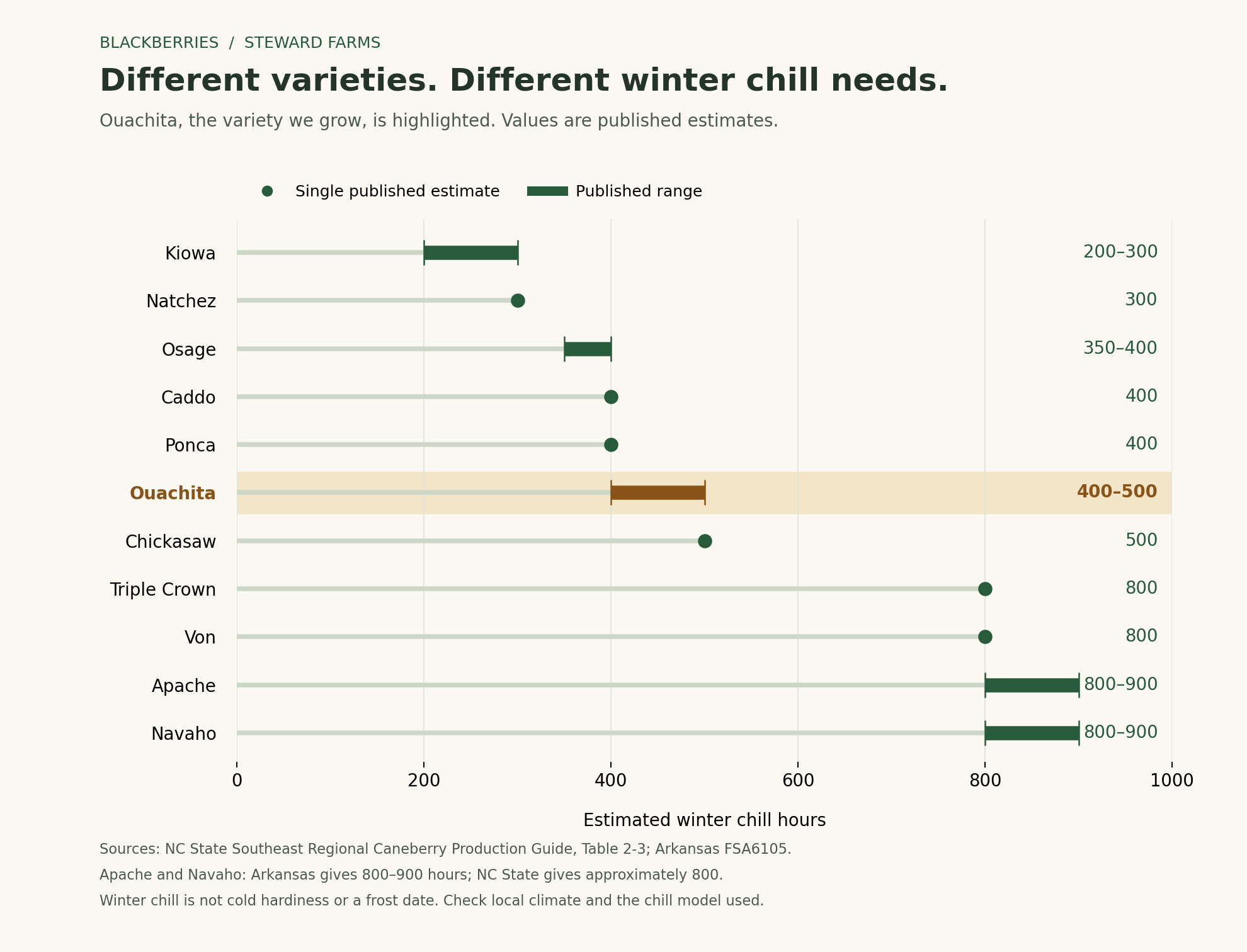
Ouachita has an estimated requirement of 400–500 winter chill hours in the Arkansas home-garden publication and NC State’s cultivar guide. This is accumulated exposure during the seasonal cycle, not a continuous number of hours every new owner should put a plant in a refrigerator.
Different chill models count temperature exposure differently. Our location map uses hours from 32°F through 45°F. A total from a different model should not be treated as interchangeable merely because both are called chill hours. Mississippi State’s explanation helps make that distinction clear.
Cold hardiness is another question. A place may accumulate enough chilling and still expose canes to damaging winter conditions. Spring frost is another question again. Meeting a seasonal chill estimate does not mean a green plug can be planted into any forecast. The point of learning these terms is to make separate decisions with the right information.
Compare varieties without turning the chart into a ranking
The variety chart shows published chill estimates for 11 floricane-fruiting blackberries. Ouachita is highlighted because it is the variety we grow. Some entries are ranges; others are approximate single estimates. The visual preserves that difference rather than making every cultivar appear measured to one precise hour.
A smaller number does not make a variety better for every garden. It describes one part of its seasonal adaptation. Flavor, growth habit, winter survival, fruiting season, and the work a household can give a planting also matter. The sources sometimes differ, so the comparison notes those differences beside the entries.
For example, the chart uses Arkansas’s 800–900-hour range for Apache and Navaho while noting that NC State lists approximately 800. That is a source comparison, not a statistical confidence interval. Read the source column before treating a graph as more exact than the evidence behind it.
Find station evidence near the receiving garden
The location map uses 605 weather stations with qualifying records across five selected October–March periods, from 2021–22 through 2025–26. Its default is the mean of those five period totals. It is recent historical context, not a forecast or a long-term climate normal.
Choose a nearby station and inspect individual winters as well as the mean. A mean can hide a lower year. The station panel keeps that variation visible and reports missing-day percentages. Clicking near a location also reports the distance to the nearest qualifying station rather than suggesting that the dot measured a particular backyard.
Georgia demonstrates why that detail is useful. The state contains different elevations and winter conditions. The farm’s selection of Ouachita does not justify painting the whole state one suitability color, and it certainly does not make every warm location elsewhere suitable. Blank areas on this map mean no qualifying station evidence in this snapshot, not zero chill.
What if the winter does not supply enough chill?
Some growers supply cold exposure in a managed production system. A 2025 Arkansas-led study included Ouachita as container-grown long canes, with dormant plants held in a walk-in cooler at about 39°F. The study then examined different storage and growing strategies. It did not establish a universal recipe for young plants or guaranteed profitability.
This is the cold-room technique readers may hear described as getting around chill hours. It changes where cold exposure comes from; it does not erase the plant’s seasonal needs. An ordinary freezer setting is not the same as the cooler treatment described in the experiment. The actual operating conditions, plant maturity, dormancy, and growing environment after storage all matter.
A June 2026 University of Arkansas report also describes growers exploring container plants, walk-in coolers, and hoop houses. That makes it a useful production topic to understand, rather than a reason to recommend an appliance to every home gardener.
Do not subtract a station’s five-period mean from 500 and call the result a cold-room treatment. That arithmetic ignores individual seasons, the actual plant, and its production history. We have collected the research and equipment considerations for readers who want to investigate that system further.
Choose a site that works after planting day
Once the climate question has been considered, walk the actual planting area. Watch where sunlight reaches it, where water remains after rain, and how a watering hose will reach new plants. Think about access for picking and cane care before calculating how many plants can fit along a fence.
UGA’s home-garden blackberry guidance emphasizes site and soil conditions. Use those principles alongside local Extension advice. A clay label does not describe the drainage of every yard, and one photograph of a planting strip cannot reveal how water moves through it after a storm.
A useful first sketch can remain modest: mark the planting strip, access space, water source, and proposed supports. Write the assumptions beside any dimensions. A diagram copied from a commercial field may include equipment alleys that differ from a household’s needs. Choose a workable care layout before turning available length into an order quantity.
Let a soil test guide amendments
The soil test is a chance to replace a guess with a recommendation. Ask the local Extension service how to collect a sample for the crop and site. Readers near the farm can use Cobb County’s soil-testing resource; readers elsewhere should use their local service.
Do this with enough time to understand the result and prepare the planting area. Buying lime, fertilizer, or a large amount of compost before reading the soil recommendation can create a second problem to solve. The treatment should follow what the site needs, not a shopping list that assumes every garden begins in the same condition.
Keep the report with the planting notes. If growth later disappoints, it supplies context for a conversation with Extension. It also stops the next season’s care from beginning with a vague memory that the bed was “amended” without any record of what changed.
Build a receiving plan around the plant stage
A green plug arriving by mail needs somewhere protected to wait while it adjusts and while the planting site is ready. That waiting space should be part of the purchase plan rather than an improvised corner found after the package arrives. Read the grower’s instructions before moving the plant into full exposure.
The same regional guide that distinguishes stock types describes hardening nursery plugs before field planting. The process is a transition, not a fixed calendar promise. Weather, previous growing conditions, and plant condition affect what happens next. Our arrival-care article follows that first transition in more detail.
An example planning week might include checking the forecast, preparing the bed, testing irrigation access, and clearing a sheltered receiving spot. The example is a way to organize work; it is not a national planting schedule. Move the date when conditions call for it instead of forcing a living plant to fit an appointment.
Check the plan before opening the planting hole
Use the decision tool to bring stock stage, local frost information, and an optional chill total together. It cannot determine your garden’s climate from its address. It asks for evidence already gathered and keeps an unknown answer unknown.
Try it as you read
Check your planting plan
If the tool raises a question, resolve that question before planting. A frost concern calls for local weather and plant-stage guidance. A chill concern calls for a longer-term cultivar decision. Poor drainage calls for a site decision. No single date, map color, or shopping link can answer all three.
The seasons belong to the Creator
The changing seasons are more than dates on our planting calendar. At Steward Farms, we acknowledge Jesus as Creator, following Colossians 1:15–17. We approach the garden as something to understand and tend with gratitude.
Genesis 8:22, in the account following Noah’s Flood, places seedtime, harvest, cold and heat within God’s continuing provision. Our climate measurements describe conditions growers need to consider within those seasons. Faith does not turn a map color into a crop guarantee; it gives us a reason to be attentive and truthful about what a plant needs.
How our spring plans fit the reader’s calendar
We are growing Ouachita blackberry plants in tissue culture now toward spring 2027. Our objective is to offer plants at $10 each, with plant shipping planned. That gives prospective growers a reason to prepare, while leaving the final offer’s plant size, readiness window, shipping charges, and supported destinations to the actual listing.
Until that offer is available, contact Steward Farms about plant availability. Tell us where the plants would grow and what stage of planning you have reached. An inquiry is not a paid preorder.
The best preparation is practical: know the variety’s climate needs, understand the plant being offered, and have a receiving site ready. Then the spring planting date becomes the result of those decisions. It no longer has to carry the weight of every unanswered question about growing blackberries.
A reader question
Does purchasing a walk-in freezer solve the problem?
The actual operating conditions matter more than the box’s name. The cooler treatment above does not support putting young plants into an ordinary freezer setting. Equipment needs to suit a defined production plan; no particular freezer conversion is validated here.
After storage, plants still need a suitable growing environment. The university’s 2026 field-day report describes growers exploring containers, walk-in coolers and hoop houses.