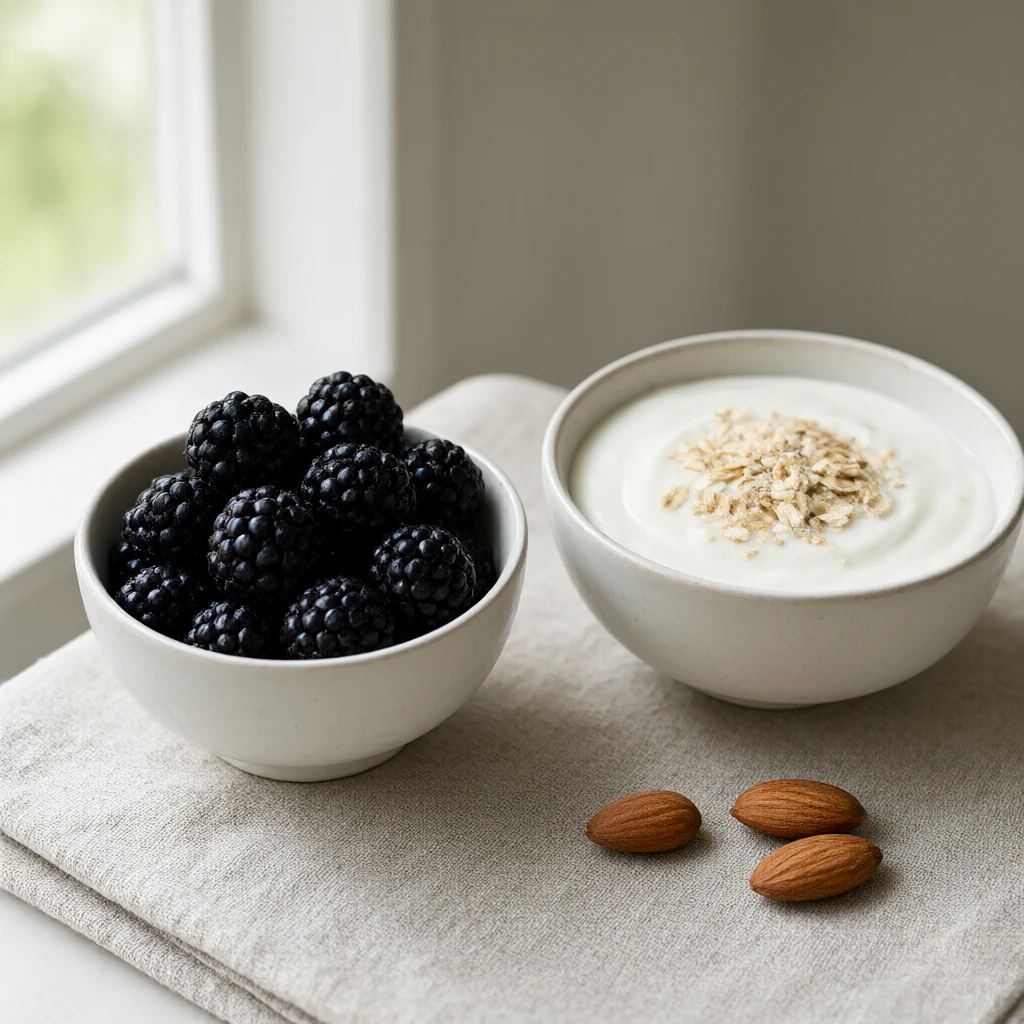
A blackberry harvest becomes useful one bowl at a time. The berries on the counter might become breakfast, a snack, a salad, or a freezer portion saved for another week. That connection between growing and eating matters to us at Steward Farms. A plant earns its place in a garden when the people tending it enjoy what comes from it.
Blackberries offer a practical nutritional benefit without needing an extravagant health promise: a reference cup of raw berries provides about 7.6 grams of dietary fiber. That gives a household something concrete to work with. A serving can sit beside foods already in the kitchen rather than require a new diet, supplement, or elaborate recipe. NC State’s nutrition overview supplies the reference serving information.
Ouachita is the blackberry variety we grow. Its thornless canes and eating qualities help connect the garden with the table. We do not claim its berries contain more fiber than other varieties; the nutrition reference describes raw blackberries generally. The attraction is the combination of an enjoyable fruit and a plant worth learning to grow.
Start with a portion you can picture
A cup is a volume measure. It is useful for planning a bowl of fruit, but berries differ in size and the spaces between them differ too. The nutrition reference uses a 144-gram cup. Someone counting food intake closely should keep that serving weight in mind rather than assume every loosely filled mug contains the same amount.
For ordinary meal planning, portions can stay simple. A half-cup calculation provides about 3.8 grams of fiber from the berries; a quarter cup provides about 1.9 grams. Those are proportional estimates calculated from the reference cup, not separate tests of different portions. The federal food sources of fiber table also lists blackberries among food sources that can contribute to a varied eating pattern.
There is no requirement to eat an entire cup at once. A smaller portion that gets eaten can be more useful than a large serving prepared with good intentions and left untouched. Start with the amount that fits the meal, the appetite, and the harvest available.
Try the serving builder
Choose a blackberry portion and a meal below. The tool estimates the fiber supplied by the berries and suggests a way to serve them. It does not calculate the rest of the meal, set a personal intake target, or tell anyone how to treat a health condition.
Try it as you read
Build your berry serving
Use the result as a planning aid. If a half cup fits a breakfast bowl, keep that portion in mind when dividing a harvest. If a recipe uses fruit for several people, divide the recipe’s berry amount among its actual servings before calling it an individual portion. A nutrition number becomes clearer when it describes what someone will actually eat.
Breakfast can stay familiar
Oats, plain yogurt, and blackberries make a useful starting combination because each component can be adjusted separately. Cook the oats as usual. Add a portion of berries after cooking if you want them to keep their shape, or stir them through while warm if you prefer their juice to spread through the bowl. Place the yogurt alongside or spoon it over the top.
This is a serving idea, not a nutritionally tested recipe. The type of yogurt, amount of oats, extra sweetener, and other toppings change the meal. Keeping those ingredients visible makes more sense than assigning the entire bowl the nutrition values of its fruit.
A household can also set out the berries separately. One person may want them on toast, another beside eggs, and another in oats. Growing fruit does not mean everyone has to eat it the same way. A bowl on the breakfast table makes the harvest available without turning it into a project.
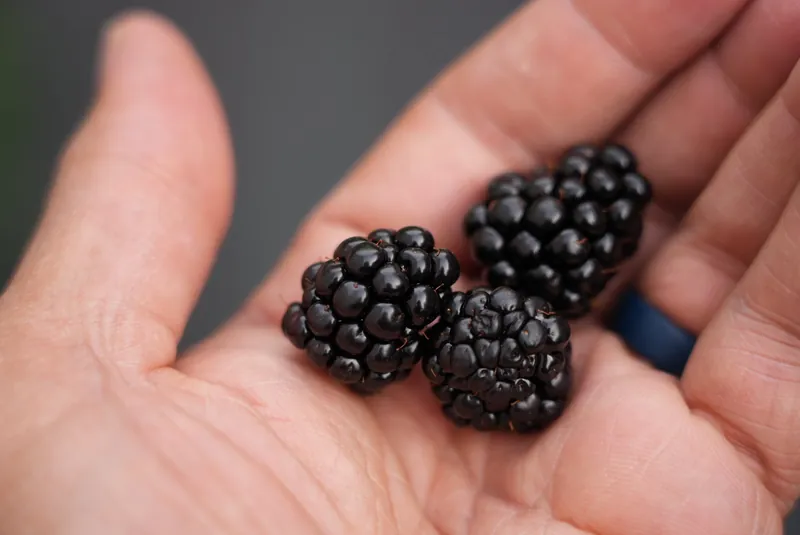
A savory lunch gives the berries another job
Blackberries do not have to stay in desserts. Try a small portion in a grain salad with cooked grains, leafy greens, chopped nuts, and a dressing the household already enjoys. Add the fruit near serving time so it remains a distinct part of the plate rather than disappearing during mixing.
The point is to use contrast: the berry brings juice and sweetness, the greens bring another texture, and the rest of the salad makes it a meal. Taste before adding more sweet ingredients. A ripe blackberry may provide enough sweetness for the combination you have made.
For lunches packed ahead, keep fragile fruit in its own small container until eating. That separates the decision to use berries from the decision to mix them into everything the night before. The same portion can move between a salad and a snack if the day changes. Flexible plans tend to use more of what is already in the refrigerator.
Snacks do not need a recipe
A serving of blackberries beside nuts, cheese, or another familiar snack can be enough. This is especially useful when the harvest arrives in small amounts. A few ripe berries can have a place on the plate without waiting until there is enough fruit for a whole pie.
Count the berries as fruit, not as permission to ignore everything served with them. The nutrition of a snack depends on the complete combination and its portion sizes. Adding berries to a large dessert does not turn that dessert into the equivalent of plain fruit.
Keep the serving process easy. Choose a bowl that fits the fruit, handle the berries gently, and put away what will not be eaten. A complicated presentation can make a small harvest feel like work. The goal is to enjoy the fruit while it is in good condition, with enough attention to avoid crushing or wasting it.
Save some fruit for a different week
Fresh berries invite immediate use, but a freezer can spread the harvest across more meals. A small, dated portion is easier to use than an unmarked container filled without a plan. Think about where the fruit will go after thawing: oats, a sauce, baking, or a blended preparation may welcome a texture that differs from freshly picked berries.
For the actual freezing steps, follow the University of Georgia’s blackberry-specific preservation instructions. Preparation matters; advice for a different berry is not automatically interchangeable. We walk through the household decisions in our harvest and freezing guide.
Do not promise that every nutrient stays unchanged through every storage method. Food preparation, storage conditions, and time affect what reaches the plate. The practical advantage here is having sound fruit available for a meal that will actually be made.
Understand what the dark color tells you
Blackberries contain plant compounds called anthocyanins, which contribute to their dark color. They are one reason researchers study these fruits. But a compound’s behavior in a laboratory is not the same as a demonstrated effect from an ordinary serving in a person’s day. Virginia Tech’s overview distinguishes research settings while discussing blackberry nutrients and plant compounds.
That distinction lets the article remain helpful. We can describe fruit, fiber, and serving sizes without promising that a bowl prevents a disease, guarantees weight loss, or replaces treatment. There is enough value in a food people enjoy and can include in varied meals.
Our earlier blackberry nutrition article introduces the broader subject. Here the useful question is narrower: how does this fruit fit into an ordinary week? Answering that question well requires more attention to habits and portions than to impressive-sounding health language.
What nutrition professionals add to the picture
Registered dietitian Julia Zumpano, RD, LD, explains in Cleveland Clinic’s blackberry overview that berries contribute fiber and other nutrients and belong within a varied eating pattern. Her recommendation to include a range of fruits and vegetables fits the way we want readers to use a harvest: enjoy blackberries without expecting one food to do every nutritional job.
University of Maine’s raspberry and blackberry bulletin was originally developed by Extension Nutrition Specialist Nellie Hedstrom and revised by Extension Professor Louise O. Kirkland. Its emphasis on serving choices is useful here. Fruit served plainly and fruit covered with added sugar or rich toppings are different eating experiences; the extras need their own place in the meal’s accounting.
Nutrition researcher Alice H. Lichtenstein, DSc, contributes another useful distinction in Tufts’ discussion of berry season: portions and added sweeteners deserve attention when choosing dried fruit. A handful of dried berries is not the same volume of food as a bowl of fresh berries. Read the package and consider the form being used.
These published perspectives support practical choices about variety, portions and preparation. They do not establish a unique nutrient advantage for Ouachita or turn this farm article into a personalized nutrition plan.
A physician’s perspective on berries
Physician and nutrition researcher Dariush Mozaffarian, MD, DrPH, puts the research in context in Tufts Health & Nutrition Letter’s berry-season article:
“In observational studies, berries consistently pop up as a key subtype of fruit associated with lower risk of major diseases.”
His comment concerns berries as a group, which includes blackberries. Observational research identifies associations; it does not establish that eating blackberries prevents disease. For a household deciding what to put on the breakfast table, the useful takeaway is to give enjoyable whole fruit a regular place within varied meals. This published comment addresses food and health, rather than a particular cultivar or farm.
Why Ouachita belongs in this conversation
A gardening decision involves more than the final nutrition label. Can the grower reach the fruit? Does the planting fit the space? Will someone use the harvest? Ouachita’s thornless, erect growth habit is part of why it interests home growers. Arkansas’s cultivar information also documents its fruit-quality traits.
Those features do not make the plant maintenance-free. Canes need care, fruit needs picking, and the site needs to suit the variety. The enjoyment comes from making those jobs manageable and connecting them to something the household wants to eat. A practical growing choice can make a food habit feel closer to the back door.
Read our Ouachita plant guide before deciding on a planting. It explains the variety more fully. If sweetness is the question keeping you from enjoying blackberries, our sweetness article provides another useful starting point.
The Creator behind the nourishment
At Steward Farms, we give Jesus the credit as Creator of the blackberry and the life that brings food from the earth. Colossians 1:15–17 grounds that conviction in its teaching that creation came through Him and is sustained in Him. Studying a fruit’s nutrients gives us another reason to thank Him for what He provides.
From Adam and Eve in the garden to Noah and his family after the Flood, Genesis presents food as God’s provision. Genesis 1:29 speaks of plants and fruit given for food; Genesis 9:3 recalls that provision when God addresses Noah. We understand blackberries within that created abundance. These passages do not name blackberries or document them as a staple on those families’ tables, and Ouachita itself is a modern cultivated variety.
Our response is gratitude expressed through care: grow honestly, handle the harvest well, and share food people can enjoy. A bowl of blackberries can invite attention to its fiber and flavor while also reminding us of the One who made the plant world possible.
Make a harvest-use plan before filling the bowl
Choose two uses for fresh fruit and one for frozen fruit. For example, a household might plan breakfast bowls, a snack plate, and small portions for later oats. This is an example of organizing food, not a promise about how much a plant will yield.
Then look at the coming week. A meal that requires ingredients nobody has bought is less dependable than a breakfast already on the calendar. Match portions to those real meals. If plans change, move the sound fruit into an appropriate preservation routine rather than waiting for the original idea to become convenient again.
Steward Farms intends to sell fresh blackberries as well as plants. These are two ways to enjoy the same crop: buy fruit when it is available, or learn the care that lets a suitable garden produce its own. Neither choice needs a health miracle to make it worthwhile. Start with one meal you already like and give a portion of blackberries a place in it.
A reader question
Does this measure Ouachita specifically?
No. The source describes raw blackberries generally; we do not claim a special fiber advantage for Ouachita.